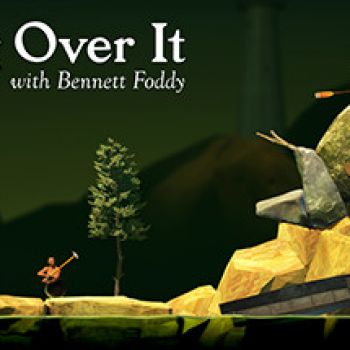
Game Overview
Getting Over It is a physics based climbing challenge that places the player in a single screen environment. The player controls a character seated in a cauldron and equipped with a large hammer. The objective is to ascend a series of abstract obstacles using only the hammer to push, pull and swing the character upward. The game is known for its unforgiving difficulty and the emotional roller coaster it creates as progress can be lost with a single misstep.
Core Experience and Difficulty
The appeal of Getting Over It lies in its pure focus on player skill and perseverance. There are no menus, no power ups and no checkpoints. Each movement must be calculated and each swing must be timed. The physics engine reacts realistically, meaning that momentum can be both a friend and a foe. The lack of guidance forces the player to experiment, learn from failure and develop a personal rhythm.
The visual style is minimalist, using a simple colour palette that emphasizes the shape of each obstacle. The soundtrack consists of a calm narration that comments on the player’s journey, adding a philosophical layer to the otherwise stark presentation.
Why the Game Feels So Punishing
The punishment comes from the fact that any loss of balance can send the character sliding back down to a previously conquered area. Because there are no lives, each fall feels significant. The game does not provide a map or a progress indicator, so the player must rely on memory and visual cues to gauge how far they have traveled.
Practical Guidance for New Players
Even without a detailed control list, there are general approaches that help new players avoid the most common pitfalls. First, adopt a slow and deliberate movement style. Rushing the hammer often results in overshooting a platform and falling.
Second, focus on building a stable base before attempting a large swing. Position the hammer so that the tip rests against a solid edge, then apply a gentle push to generate momentum. Once the character is moving, keep the hammer close to the body to maintain control.
Third, learn to read the shape of each obstacle. Some surfaces are angled in a way that encourages a rolling motion, while others require a precise vertical lift. Observing the angle before committing to a move can save a lot of frustration.
Fourth, practice the art of small adjustments. Tiny nudges with the hammer can correct a drift without resetting the entire climb. Patience in making these micro corrections often prevents a large fall.
Developing a Personal Rhythm
Because the game does not impose a timer, players are free to set their own pace. Many find that establishing a steady rhythm of push, release and reposition creates a flow state. When the rhythm is broken, the likelihood of a slip increases. Experiment with different tempos until a comfortable cadence emerges.
Community, Replay Value and Shared Experiences
Getting Over It has cultivated a strong community of players who share videos of their attempts, both triumphant and disastrous. Watching these recordings can provide insight into alternative techniques and inspire new strategies. The game’s open ended nature means that each playthrough can feel fresh, as the player may choose to tackle the climb from a different angle or attempt to improve on a previous run.
The lack of a definitive ending encourages repeated attempts. Players often set personal goals such as reaching a certain height without falling or completing the climb within a specific time frame. These self imposed challenges add layers of replayability beyond the basic ascent.
Common Questions
Is there a way to save progress?
No. The game does not feature a save system. Each session starts from the bottom and the player must climb the entire course in a single attempt.
Can the difficulty be adjusted?
The difficulty is built into the physics and the design of the obstacles. There are no difficulty settings, so the challenge remains consistent for every player.
What platform can I play on?
The game is available on personal computers through web browsers. It can be accessed directly without the need for additional software.
Do I need any special hardware?
No special hardware is required. A standard keyboard and mouse are sufficient to control the hammer and navigate the environment.
How long does it typically take to finish?
The time varies greatly depending on skill level and perseverance. Some players complete the climb in under an hour, while others may spend many hours over several sessions before reaching the top.